



Israeli Court Takes Aim at Leveraged Acquisition Structures – Francisco Partners Structure Deemed an “Artificial Transaction”
2 August 2026
On July 28, 2026, an Israeli District Court sent a sharp warning to multinational groups, private equity funds, and other acquirers using leveraged structures to acquire Israeli companies. In Q Cyber Technologies Ltd. v. Kfar Saba Assessing Officer, the Court held that the structure used in Francisco Partners’ acquisition of an Israeli target company constituted an “artificial transaction” under the Israeli general anti‑avoidance rule in Section 86 of the Israeli Income Tax Ordinance (the “Ordinance”). The ruling puts acquisition financing structures involving Israeli targets under far more intense scrutiny.
This is the first court ruling addressing this common structure for acquisitions of Israeli companies, an issue that has recently become increasingly frequent in disputes between Israeli companies (and multinational groups) and the Israel Tax Authority (the “ITA”).[1]
We emphasize that this is a District Court decision only and does not create binding precedent. It may be appealed to the Supreme Court, and other District Courts may reach different outcomes on similar facts. Nonetheless, it signals a more aggressive application of the artificial transaction doctrine and warrants careful review and reconsideration of acquisition structures involving Israeli target companies.
Transaction Structure and Tax Outcome
In 2014, Francisco Partners (“Francisco”), acquired NSO Group Technologies Ltd. (“NSO”), an Israeli cyber company, for USD 70 million in cash and additional share consideration valued at about USD 17 million.
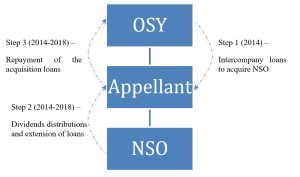
The acquisition structure was as follows:
- Q Cyber Technologies Ltd. (the “Appellant”), an Israeli shelf company with no activity, employees or bank account at the time, was acquired by OSY Technologies S.A.R.L. (“OSY”), a Luxembourg company in the Francisco group (the “Group”).
- OSY extended long‑term intercompany loans of roughly USD 87 million to the Appellant, nominally to finance the Appellant’s acquisition of NSO’s shares.
- The loan proceeds did not pass through the Appellant’s bank account; they were transferred directly from OSY to NSO’s selling shareholders.
- During 2014-2018, the Appellant repaid these loans using dividends and loans it received from NSO. In practice, NSO’s funds flowed directly to OSY, again bypassing the Appellant’s account, although the cash movements were recorded in the Appellant’s books.
In simplified terms, the structure was as follows:
As of 2016, two years after the acquisition, the Appellant began generating taxable income in Israel from the provision of services to affiliates in the Group pursuant to a cost-plus remuneration model. The Appellant had annual revenue in 2016 through 2018 ranging from USD 4 million to USD 19 million, and its Israeli employee headcount increased from 4 in 2015 to 112 in 2021. However, it never acquired additional companies, and subsequent acquisitions by Francisco were made by another Group entity.
Overall, about USD 86 million of NSO’s profits were remitted to OSY (a Luxembourg company) by way of repayment of the acquisition financing loans without Israeli dividend withholding tax.
In 2019, Francisco sold the Appellant to a third-party buyer, realizing significant capital gains.
Court’s Analysis Under Israeli General Anti-Avoidance Rule
Section 86 empowers the assessing officer to disregard and recharacterize an arrangement that is artificial or whose main purpose is an “improper tax reduction.”
Based on established Israeli case law, the Court noted that a transaction would be considered artificial only if:
- It qualifies as a “negative tax planning” (i.e., it exploits a gap in the law contrary to its purpose); and
- It does not have a substantial commercial purpose beyond tax savings.
The Court concluded that the structure constituted negative tax planning, and that the Appellant failed to prove a fundamental commercial purpose. In particular, the Court emphasized that the Appellant was a shelf company prior to the acquisition rather than an active company, and that it did not provide sufficient evidence to support the commercial reasons it raised to justify the structure.
The Court noted that the Appellant did not prove, among other things, that it was actually involved in subsequent acquisitions; that the acquisition of NSO was necessary for the Appellant’s services activity; or that it was important, for regulatory reasons, that NSO’s shares be held by an Israeli company.
The Court stressed that such considerations might be relevant and could, in principle, render such an acquisition structure legitimate (i.e., not artificial). However, they must be supported by clear and substantial real‑time evidence, such as:
- formal documents of the acquiring company;
- expert opinions or advice; and
- materials from the negotiations between buyer and seller prior to the acquisition.
According to the Court, this evidence must demonstrate that the commercial purpose is significant and outweighs the tax motive.
As a result, the Court upheld the ITA’s recharacterization of the payments from the Appellant to OSY as dividends, rather than loan repayments, and applied a 10% withholding tax under the Israel-Luxembourg treaty to the amounts paid.
The Court also noted that the dividend amount subject to withholding tax would not exceed the Appellant’s distributable earnings under Israeli corporate law. This limitation is significant because amounts in excess of distributable earnings generally should not be treated as dividends subject to withholding tax. Although the ruling does not state this expressly, it appears that the Appellant did not have earnings sufficient to cover the full amount of the loan repayments.
Practical Takeaways for Multinational Groups
Although the decision is not binding, it raises several practical points and recommendations:
- Leveraged acquisitions remain possible, but must be carefully structured.
The decision does not prohibit the use of intercompany debt or acquisition vehicles, but underscores that their use must be supported by robust, demonstrable commercial rationales. - Real‑time documentation is critical.
Contemporaneous documentation clearly articulating non‑tax reasons for the structure (business, regulatory, operational, financing or exit considerations) is essential to withstand scrutiny under Section 86. - Substance should exist from the outset and be enhanced over time.
The acquiring entity should have meaningful substance, including decision‑making, functions, and its own bank account and personnel, from an early stage, and that substance should be developed consistently over time. - Existing structures should be reviewed.
Multinational groups should review existing acquisition and financing structures involving Israeli entities and enhance both documentation and substance where relevant. Such review should take place prior to repaying any acquisition financing debt.
Our tax department has extensive experience in structuring acquisitions of Israeli companies and defending intercompany financing structures in tax audits. We are available to discuss the potential implications of the Q Cyber ruling for your group and to help design robust, defensible structures going forward.
Sincerely,
Tax Department
Herzog Fox & Neeman
[1] In a 2023 court case involving a similar acquisition structure, the ITA did not raise any artificial transaction claims. See T.A. 51066-03-20, eBay Israel Holding Ltd. v. Netanya Assessing Officer (2023).
Have a question on this topic? We are here to help
Every case is unique. Let's talk about yours.