
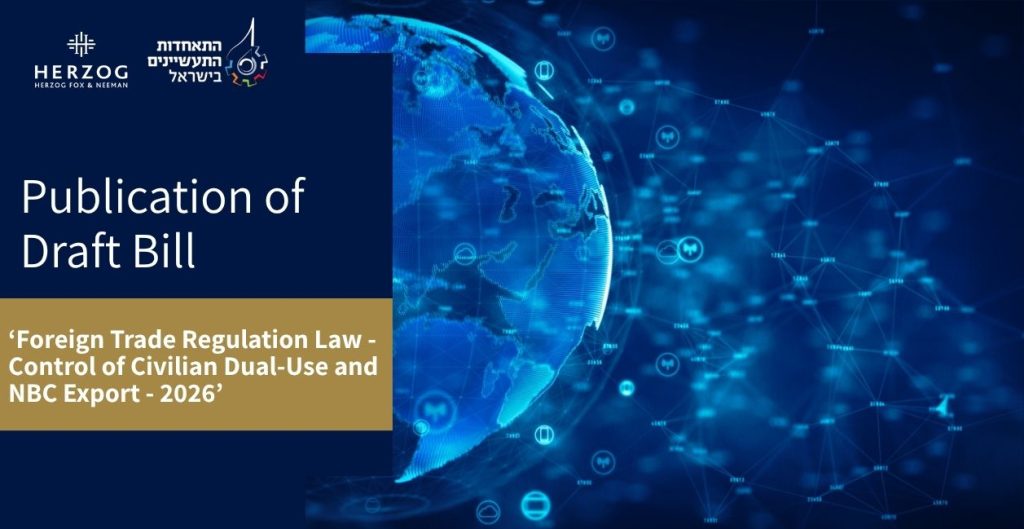
Publication of Draft Bill: ‘Foreign Trade Regulation Law – Control of Civilian Dual-Use and NBC Export – 2026’
30 April 2026
We wish to inform you that the Ministry of Economy and Industry has recently published a Draft Bill titled “Foreign Trade Regulation Law – Control of Civilian Dual-Use and NBC Export – 2026”, as part of a legislative initiative to establish a primary statutory framework governing civil dual‑use export controls in Israel, including control of exports of nuclear, chemical and biological (NBC) materials.
This is a draft of primary legislation, currently open for public comments, which seeks to create a modern, comprehensive statutory export control regime in Israel. The proposed framework is based upon, inter alia, existing Israeli export control principles as well as comparable export control regimes in leading jurisdictions (including the United States, the EU, the United Kingdom, and others), and seeks to align with Israel’s international commitments in the field of non‑proliferation of weapons, NBC materials, and prohibited end uses.
The draft bill is accompanied by a Regulatory Impact Assessment (RIA), which reviews international export control regimes, analyzes deficiencies in the current Israeli regulatory framework, and outlines the identified regulatory problem and its underlying causes — including the absence of primary legislation and the growing use of civilian dual‑use technologies with potential risk.
Invitation to Submit Comments
The draft bill is open for public comments. Deadline for submission of public comments: May 10, 2026
The Manufacturers Association of Israel and Herzog Fox & Neeman are in ongoing discussions with the Ministry of Economy and intend to submit a coordinated position paper, including substantive comments and practical recommendations regarding the wording and implementation of the proposed framework, as part of the public consultation process.
We invite you to take part in shaping the new regulatory regime and would welcome your observations, comments, suggestions, business‑oriented regulatory considerations, implementation concerns, or proposals for easements and exemptions by May 6, 2026, to enable us to consolidate and submit an organized and comprehensive response.
Key Proposed Innovations in the Draft Bill
The draft bill introduces a range of significant changes expected to affect industrial companies, technology companies, and civilian product exporters, including:
🔹 Primary Legislation Framework
- Anchoring broad control powers, and administrative and criminal enforcement powers, in primary legislation
- Establishment of a advanced enforcement mechanism: warnings, undertakings, administrative monetary sanctions, and forfeiture of goods
- Personal liability of company officers, with an emphasis on internal compliance infrastructures
🔹 Administrative Review and Appeals
- Formal administrative review and appeal mechanisms against decisions of the authority
- First‑time statutory regulation of review procedures in the civillian dual‑use export control field
🔹 Oversight of Foreign‑Related Activities
- Extension of licensing requirements to brokering between foreign parties, technical assistance, and the transfer of knowledge relating to dual‑use items and NBC‑related items to a civilian user
- Enhanced control of activities involving foreign entities and international collaborations
🔹 Sanctions Regimes and Catch‑All Controls
- Explicit integration of international sanctions regimes, including anti‑circumvention provisions
- Extending licensing requirements to items not explicitly listed (“catch‑all”), to be determined by the Ministry of Economy on a case‑by‑case basis, based on end use or concerns regarding prohibited use
🔹 Inter‑Ministerial Balance
- A trend toward reducing reliance on positions of the Ministry of Defense and the Ministry of Foreign Affairs, while strengthening the role of the Ministry of Economy as the leading civillian goods regulator
- Preservation of inter‑ministerial consultation mechanisms, alongside efforts to reduce regulatory barriers
🔹 Exemptions, Recordkeeping, and Compliance Obligations
- Establishment of statutory exemptions and exemptions by regulation
- Authority to require compliance programs as a condition for licensing
For further information, to coordinate a discussion, or to submit comments, please contact us.
We will continue to update you on further developments.
The Manufacturers Association of Israel, Ron Garame High- Tech Sector Manager & Business Developer
Herzog Fox & Neeman, Department of Defense, Regulation, and International Law, Raanan Sagi | Partner
Have a question on this topic? We are here to help
Every case is unique. Let's talk about yours.